
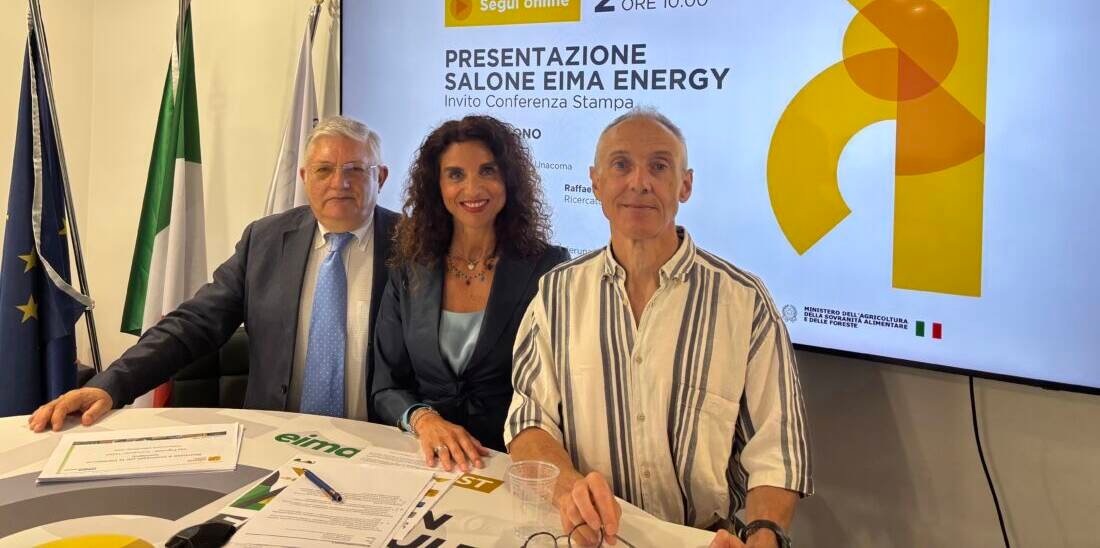
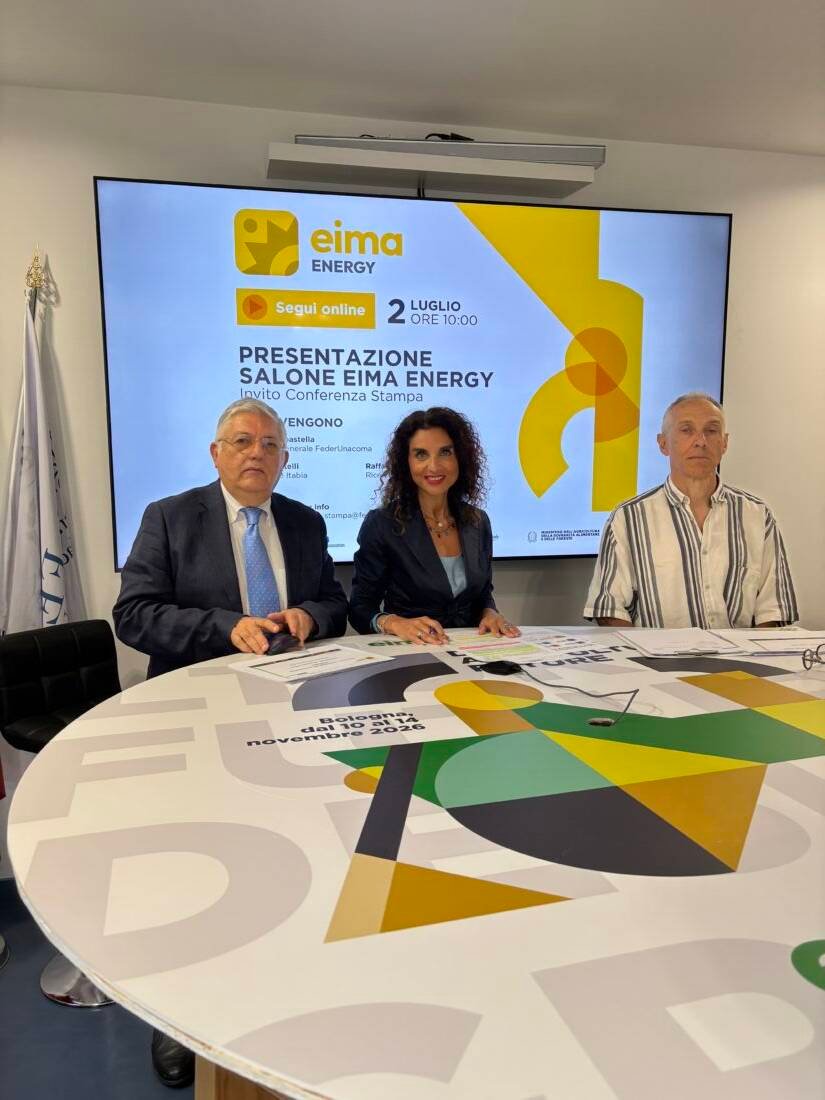
The 11th edition of the International Bioenergy Showcase, organized by FederUnacoma and Itabia, was presented this mornin durng a dedicated press conference. The event will take place in Bologna from November 10 to 14. Durig todays event, emphasis was placed on the significant contribution (22%) of renewable energy to the Italian energetic demand and on the strategic role of bioenergy. EIMA will feature a large demonstration area and a program of conferences and technical seminars to educate farmers, technicians, and industry professionals about the qualities of fuels derived from agricultural and forestry biomass.
Italy’s energy sector is becoming increasingly “green.” In 2024, the contribution of renewable sources to gross final energy consumption grew up to 30.6 Mtoe (million metric tons of oil equivalent) covering approximately 22% of the national energy demand, estimated by the Italian Ministry of the Environment and Energy Security at 140 Mtoe, which is equivalent to more than one billion barrels of oil.
The increase in production from environmentally friendly sources (bioenergy, hydroelectric, solar, wind, heat pumps, and geothermal energy) has made it possible to significantly reduce domestic demand for fossil fuels, cutting the equivalent of over 210 million barrels of oil in a single year.
This was revealed during the press conference dedicated to the presentation of EIMA Energy, held this morning via live stream from the FederUnacoma headquarters in Rome.
EIMA Energy is one of the seven specialized trade shows of EIMA International—as explained during the meeting—one of the world’s leading exhibitions for the agromechanical sector, which will be held at the Bologna Exhibition Center from Tuesday, November 10, through Saturday, November 14. The conference—which featured remarks by Simona Rapastella, general manager of FederUnacoma (the association within Confindustria that represents agricultural machinery manufacturers and is the direct organizer of EIMA); Vito Pignatelli, President of Itabia, the Italian Biomass Association, which, together with FederUnacoma, organizes EIMA Energy; and Raffaele Spinelli, a researcher at CNR IBE.
“Bioenergy,” explained Pignatelli, “is derived from numerous sources, ranging from forest wood to agricultural processing residues, from livestock manure to agro-industrial waste and the organic fraction of municipal solid waste, and offers excellent energy yields thanks to the plant technology available today.” “Among the advantages offered by biomass,” added the president of Itabia, “it is worth noting its great flexibility, which allows these resources to be used for the production of electricity, heat, and transportation fuels, as well as its easy availability locally, in addition to zero greenhouse gas emissions, which make bioenergy one of the most environmentally friendly sources of all.”
“To establish efficient bioenergy supply chains,” Raffaele Spinelli emphasized in his remarks, “it is essential to have mechanization that covers the entire cycle, from biomass harvesting to transportation, through processing, and on to the plant systems for energy conversion.” “Forestry tractors, telescopic handlers, residue shredders, and many other types of vehicles, equipment, and systems are now produced by specialized manufacturers,” Spinelli noted, “and will be on display at EIMA Energy.”
For many years, the Bologna trade show has been a key event for operators in the bioenergy sector, as well as for agricultural and agro-industrial companies that need to dispose of residues and byproducts while also seeking low-cost energy for their operations.
“Ever since its first edition, the EIMA Energy has served as a showcase for technological innovations in the sector, but also as a major demonstration event,” said Simona Rapastella, “since a large part of the showcase is set up outdoors with machines in operation, to demonstrate to the public the technical characteristics and effectiveness of the equipment used.” This year, the demo area will be strategically located within the fairgrounds—it was explained—in the area between Pavilion 26 and Pavilion 30, near the Michelino entrance. During the exhibition, there will also be presentations by researchers from CNR IBE, as well as a series of technical seminars on growth opportunities in the circular bioeconomy and the role of modern mechanization in the development of the various supply chains within this promising sector and in modern forestry.
“Never before has it been as important as this year to promote bioenergy supply chains,” explained the director of FederUnacoma, “because they offer a concrete response to the major challenges ahead: the climate challenge, which demands alternatives to fossil fuels, and the energy challenge, given that our country is poor in ‘traditional’ energy sources but rich in vegetation and agricultural production with great potential.”
Relying on its own resources, our country could produce over 16 Mtoe of thermal energy from biomass by 2030. Considering that a medium-to-large oil tanker can carry between 120,000 and 200,000 metric tons of oil—as was mentioned by way of example during the conference—the potential of 16 Mtoe would be equivalent to the cargo of 80–140 oil tankers each year.