
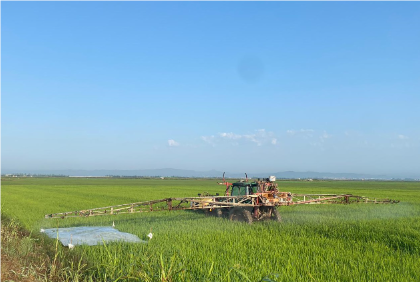
Currently, the control of pyricularia is conducted through preventive and generalized fungicide treatments based on the farmer’s visual perception, which can cause unnecessary application of phytosanitary products. For this reason, DETECTORYZA, which began in the spring of 2022 and will continue until the autumn of this year, is trying to find a system to control the fungus in the initial phases of the infection before the epidemic development of the disease occurs in the parcels. It is about anticipating the fungus spreading through remote sensing with satellites and drone flights in those areas and plots in which an incipient appearance of the infection is detected so that targeted and focused treatments are more effective.
The project is being developed in the Albufera de València Natural Park and is financed by the Valencian Innovation Agency. It is led by the UNIANA Cooperative from Sueca, and has the technical support of the Federació Cooperatives Agroalimentàries of the Valencian Community, and with the participation in the consortium of the University of Valencia (UV), the Valencian Institute of Agricultural Research (IVIA) and the Polytechnic University of Valencia (UPV). ″The spread of the disease in the field is easy to follow with the naked eye, since you can observe stands or foci that spread rapidly to the rest of the plot. Therefore, developing a pilot methodology based on early detection of the disease by drones and satellites to reduce widespread treatments is plausible. This would avoid unnecessary travel and treatments when the infections are already very advanced and their effectiveness in controlling the disease is poor. In this way, we will contribute to optimizing the use of fungicides, carrying out selective treatments at the right times and aimed at the incipient foci of the disease,” the researchers explained in an article recently published in the journal Phytoma.
The work was conducted in nine plots in the Albufera area of Valencia and cultivated with representative varieties in Valencia. In addition to satellite images and those obtained by drones, phenological and agronomic crop monitoring has been conducted, as well as the inoculum of the fungus. The dynamics of the inoculum have been followed in the plots with and without fungicide treatments to determine, with different levels of detection and quantification, the amount of Pyricularia oryzae spores present in the air with a weekly resolution. The dynamics of the disease have been followed weekly: the severity of the symptoms is quantified according to the affected leaf area. The data captured, and properly analyzed, will be used to develop the predictive model for early disease detection.
On the other hand, DETECTORYZA tries to learn the nutritional status of the plants throughout the crop according to the data observed by satellite. In this way, it will be possible to assess the amount of fertilizer necessary and the appropriate time at which it should be added in a second application to achieve the maximum harvest, minimizing unnecessary losses and contamination.
“Currently, the traditional method consists of applying 80% as a bottom fertilizer before releasing water and the rest at the end of the vegetative phase. With the project, we are carrying out different tests with the application rates of the fertilizer, with the inclusion of urea inhibitors, thus optimizing the contribution of nitrogen,” the authors detailed in the article published in Phytoma.