
In 2025, Italy remains Turkey’s leading supplier in the agricultural machinery sector. Trade in the sector is also expected to grow in the three-year period 2027–2029. EIMA International serves as a platform for strengthening trade relations and Italian-Turkish cooperation. Over 2,300 visitors expected from Turkey. An official delegation of Turkish operators in Bologna is xexpected too; the visit organized by the ICE Agency.
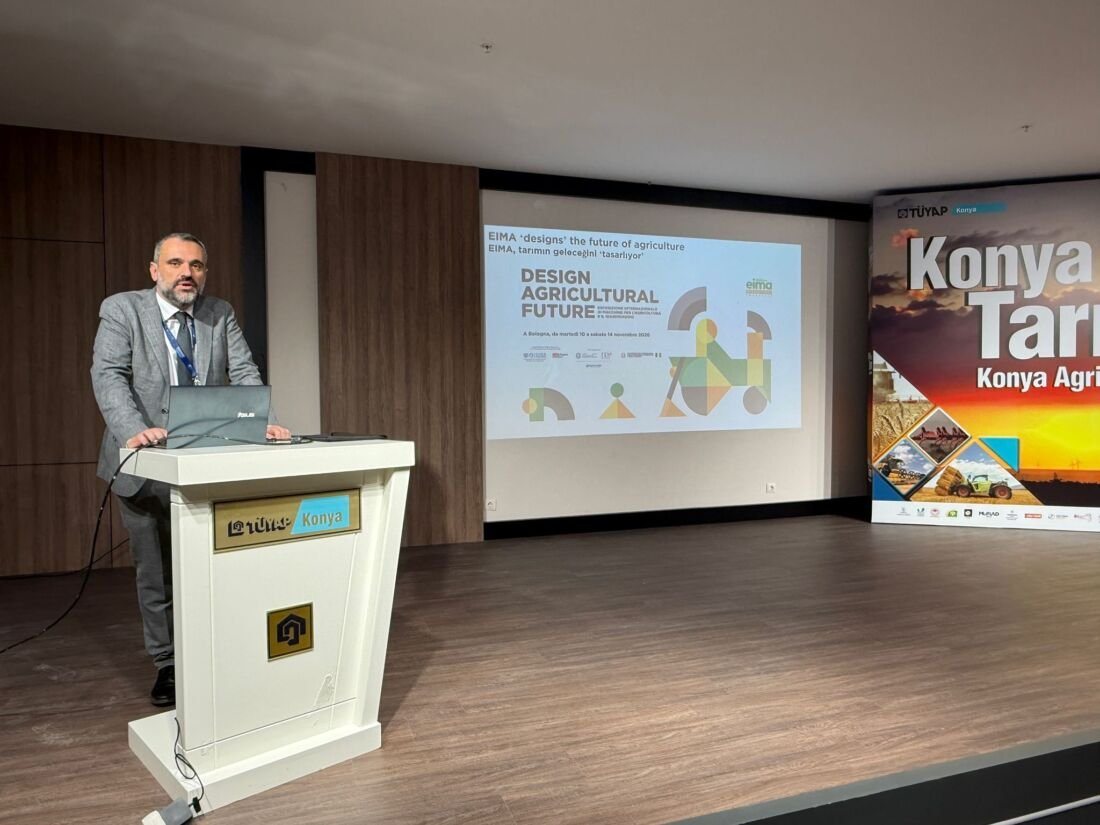
With total trade reaching nearly €500 million in 2025, Turkey remains one of Italy’s main trading partners in the agricultural machinery sector. Over the past twelve months, Italian imports of agricultural machinery from Turkey have in fact grown by 19%, exceeding €210 million, whilst exports, amounting to approximately €230 million, although down by 20% compared to the previous year, have nevertheless remained at levels well above those of the pre-pandemic years. The figures relating to trade in the sector between the two countries were released this afternoon in Konya (Turkey) during the press conference presenting the 47th edition of EIMA International, the global agricultural machinery exhibition organised by FederUnacoma in Bologna from 10 to 14 November. “The trend in Italian agricultural machinery exports was influenced by developments in Turkey’s domestic market, which saw a significant decline in sales last year.
The decline, which in the tractor sector stood at 36% (40,500 units sold), is due not only to factors such as inflationary pressures or difficulties in accessing agricultural credit, but – as explained by Davide Gallarate of FederUnacoma’s Events Office – also to the instability and climate of uncertainty in the global economic landscape”. However, the current economic climate has not weakened Italian-Turkish trade relations and technical cooperation. With a 18.2% share, Italian manufacturers confirmed their position as Turkey’s leading suppliers of agricultural machinery in 2025, whilst Turkish manufacturers saw their turnover with Italy grow to exceed €210 million. The partnership between the two countries could strengthen in the medium term if the projections by the research firm Exportplanning for Turkey are confirmed; these currently indicate a recovery in agricultural machinery imports from the main global suppliers. According to these estimates – following the expected slowdown for the current year (-5.6%) – total imports are expected to return to growth in the three-year period 2027–2029 at an average rate of 2.3% per year.
The organizers have planned several new features for the November event, starting with an increase in the number of themed showcases. “In addition to the traditional EIMA ‘Energy’, ‘Components’, ‘Idrotech’, ‘Digital’ and ‘Green’ showcases, there will be the new EIMA ‘Extend’ and EIMA ‘Campus’, dedicated respectively to organisations representing the global agricultural and agricultural machinery sector and to the world of universities, research and training. “The idea of expanding the range of showcases,” said Davide Gallarate, “was conceived to highlight two elements of the sector: governance and training, which are becoming increasingly central to the planning of sector policies.” Also worth noting, among other new features, is the opening of Hall 35, currently under construction to the highest architectural and functional standards, and the redesign of the outdoor spaces where dynamic demonstrations take place in the EIMA Energy, Tractor of the Year, Garden E-motion, Contoterzista Driver Trophy, as well as REAL, the arena dedicated to robots and highly automated machinery. Also making its debut is the first edition of the ADI Design Exhibit Award – EIMA International, a competition open to all exhibitors promoted by the Italian Industrial Design Association (ADI) in collaboration with FederUnacoma to reward the best exhibition stands.